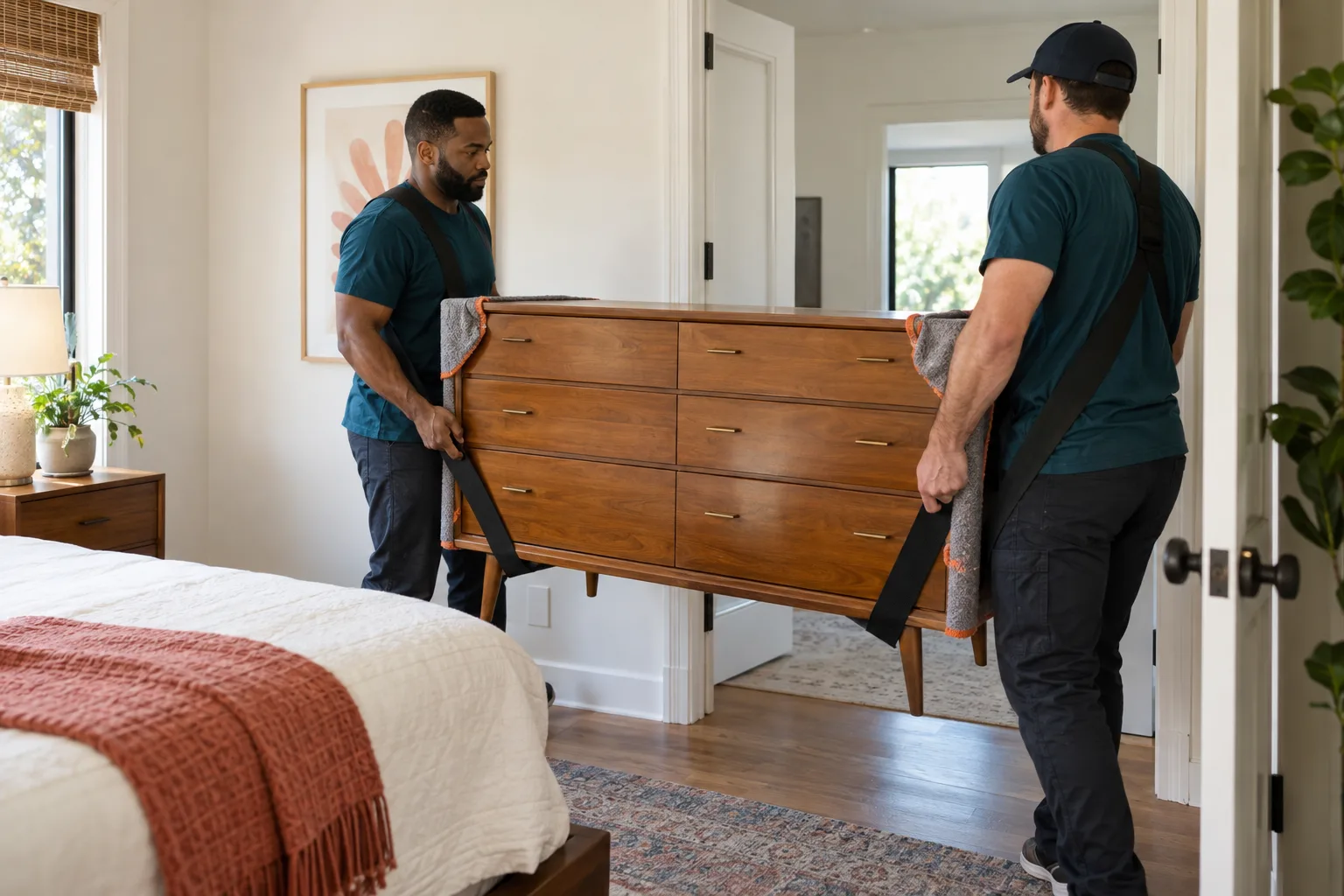
Empty every compartment
Remove clothing, jewelry, documents, drawer liners, loose hardware, and anything hidden behind or beneath the drawers. Contents add weight, shift during carrying, and can disappear inside the cabinet.
Check what is attached
Identify mirrors, stone tops, changing-table frames, anti-tip straps, cable anchors, and wall attachments. A freestanding dresser should not be assumed to be free of the wall. Tell the provider before anyone pulls it forward.
Measure fixed dimensions
Record the widest, deepest, and tallest fixed points. Measure with drawers closed. Note whether drawers are captured by stops or can be removed according to the manufacturer’s design.
Trace the carry path
Check the bedroom door, hallway turns, stair landing, railing, elevator, exterior gate, and distance to parking. Photograph tight points with enough surrounding context to show how a carrier can turn.
Protect people and property
Do not drag a heavy dresser across flooring or tip it onto an unstable edge. Leave mirrors and stone components for a handling assessment if you do not have the right equipment and help.
Planning reference: source reviewed October 10, 2026.
Need help with this item?
Review the service scope, then call with dimensions and access details.
View Dresser Removal